How to Take Smart Notes
by Sönke Ahrens
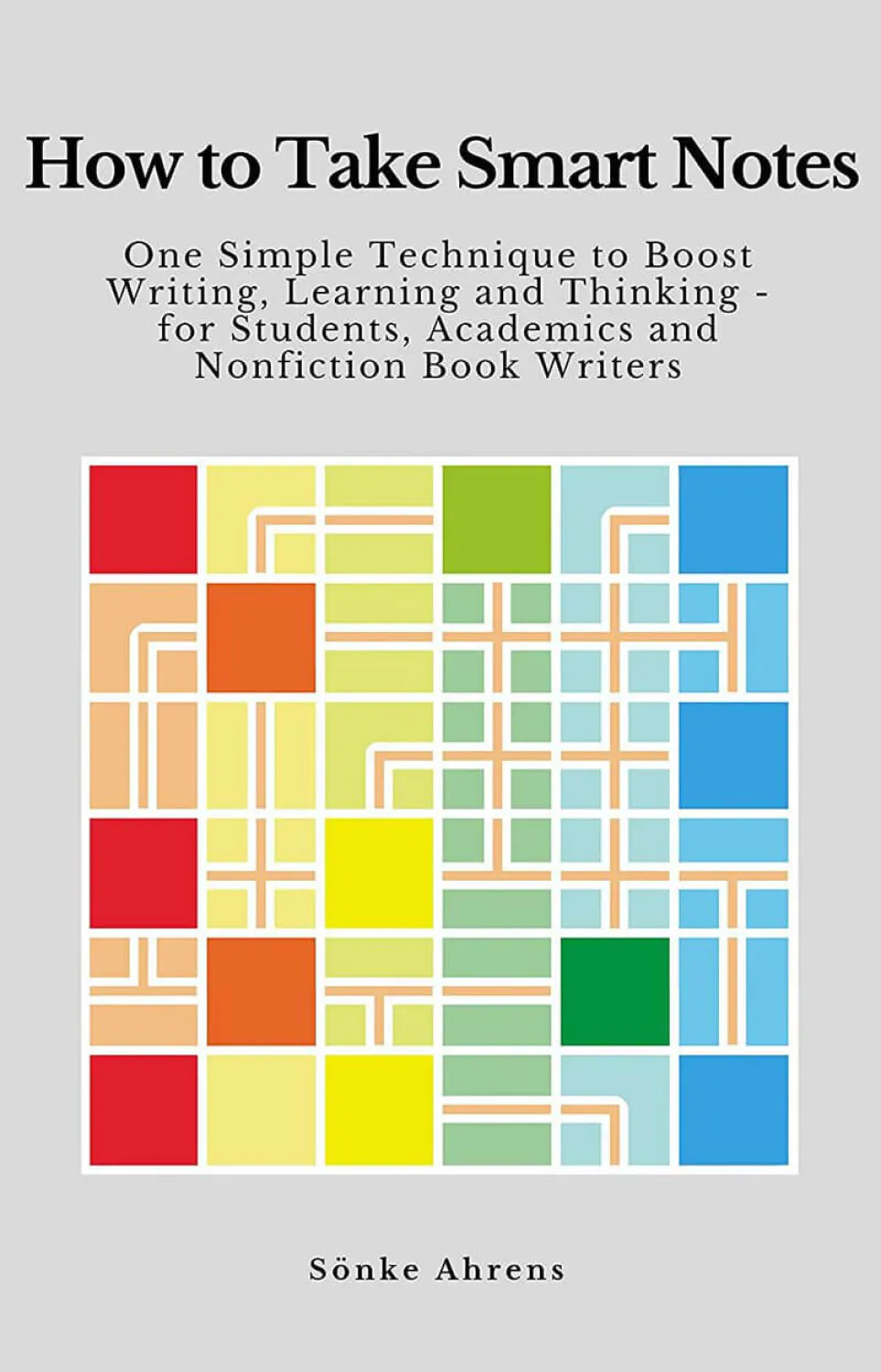
The book in 3 sentences
- How to Take Smart Notes introduces the Zettelkasten method pioneered by sociologist Niklas Luhmann—a note-taking system that transforms scattered ideas into an ever-growing, interconnected reservoir of thinking that practically writes your next piece for you.
- The core insight is that good writing begins long before you sit down to write: by taking deliberate, permanent notes as you read and think, you build up a latticework of ideas that surfaces its own topics, arguments, and connections.
- Rather than relying on willpower or rigid planning, the system is designed to work with human psychology—making the right action the easy action, so that thinking, learning, and creating become self-sustaining habits.
First impressions
I picked this up expecting a productivity book with a few tips on organising notes. What I got instead was a fundamental rethinking of how learning and writing actually work. Ahrens doesn’t just describe a system—he dismantles the assumptions most of us have about creativity, discipline, and the writing process. The book is surprisingly philosophical for what it claims to be about, weaving in psychology, cognitive science, and education theory to make its case. It challenged me to look critically at the way I had been “collecting” ideas for years without ever truly developing them.
Discovery journey
My journey to this book was itself a kind of irony—I had been hoarding articles, highlights, and web clippings for years through tools like Pocket and Day One, convinced I was building something useful. When I eventually confronted how little I actually retained or used from all that collecting, I went looking for a better way. How to Take Smart Notes appeared repeatedly in conversations about personal knowledge management and second-brain methodologies, and it quickly became clear this was the foundational text behind much of that movement.
Reader’s compass
This book is ideal for:
- Writers, researchers, and academics who struggle with blank-page paralysis or constantly starting from scratch
- Knowledge workers who consume large amounts of information but feel like little of it sticks or compounds
- Anyone who has tried note-taking apps and systems but finds their notes eventually become digital graveyards
- Entrepreneurs and creators who want a sustainable system for generating content, ideas, and insights over the long term
- Those interested in building a personal knowledge base that grows more valuable with time rather than more cluttered
Personal transformation
This book fundamentally changed how I engage with everything I read, watch, and listen to. The biggest shift was moving from collecting ideas to developing them. I recognised myself painfully in Ahrens’s description of someone who hoards ideas through clippings and read-it-later apps without ever reviewing or building upon them—my Day One notebooks being the clearest example.
The distinction between fleeting notes, literature notes, and permanent notes gave me a concrete framework I could immediately apply. More importantly, the book reframed note-taking not as an administrative chore but as the actual thinking work itself. Writing is how we demonstrate—to ourselves first—that we have truly understood something.
The permission to follow interest rather than force productivity also resonated deeply. Luhmann’s principle of only doing what is easy, of putting something aside the moment it falters, reframed “going with the flow” not as laziness but as a well-designed workflow.
Standout quotes
“Getting something that is already written into another written piece is incomparably easier than assembling everything in your mind and then trying to retrieve it from there.” — Sönke Ahrens
This single sentence justified the entire system for me. The mental overhead of trying to hold ideas in your head while writing is what makes writing feel so exhausting. The Zettelkasten offloads that burden entirely.
“Not having willpower, but not having to use willpower indicates that you set yourself up for success.” — Sönke Ahrens
This reframed how I think about productivity entirely. The goal isn’t discipline—it’s designing a workflow where discipline isn’t needed. Highly successful people succeed not because they resist resistance, but because their environment removes it.
“An idea kept private is as good as one you never had. And a fact no one can reproduce is no fact at all.” — Sönke Ahrens
A sharp reminder that thinking only becomes knowledge when it is externalised, shared, and tested. This pushed me toward sharing what I learn more openly and consistently.
Key insights
The three types of notes
Ahrens distinguishes clearly between fleeting notes (quick captures of whatever comes to mind, processed daily and then discarded), literature notes (what you want to remember and reuse from what you read, with bibliographic details), and permanent notes (fully formed ideas written in your own words, connected to existing notes, kept indefinitely). Most people collapse all three into one chaotic pile—or worse, treat every highlight as a permanent note. Each type requires different handling, and confusing them is where most note-taking systems fall apart.
Writing is thinking, not reporting
The book makes a compelling case that writing is not the output of thinking—it is the thinking. When you rewrite what you read in your own words, you are forced to confront gaps in your understanding that passive reading conceals. You can only tell if you truly understand something when you can explain it clearly to someone who doesn’t. Ahrens calls this writing as if to a reader—which is really just your future self who has forgotten the context.
The slip-box as a thinking partner
Luhmann’s archive of 90,000 notes was not a storage system but a dialogue partner. The goal is not to retrieve specific notes but to be pointed toward relevant connections and emergent patterns. The more notes you accumulate, the more the system surfaces ideas you didn’t know you had—because the connections between notes create insights that no single note contains alone.
Bottom-up vs. top-down
Most people start writing by choosing a topic, then outlining, then researching to fill the gaps. Ahrens inverts this entirely. You write permanently as you go, build up a critical mass of ideas on a topic, and let the structure emerge from what you have already thought through. By the time you sit down to write, you are not starting from scratch—you are organising what already exists.
Feedback loops and growth
The book draws a sharp contrast between fixed and growth mindsets, but grounds it practically. Reading and writing together form a positive feedback loop: writing forces you to test your understanding, reveals what you don’t know, and points you toward further reading. This self-correcting cycle is what makes the system compound over time. External rewards—deadlines, praise—are fragile motivators; the work itself becomes the motivation when the system is designed well.
Actionable takeaways
-
Capture fleeting notes immediately — carry a single place (physical or digital) for quick captures throughout the day, then process them into literature or permanent notes before you sleep.
-
Always write literature notes in your own words — resist the urge to copy quotes or highlights directly. Paraphrase what you read as if explaining it to someone else; that friction is where understanding is built.
-
One idea per permanent note — keep notes short enough to read without scrolling. This forces clarity and makes notes combinable later.
-
Link notes to notes, not just to tags — tags create silos; links between notes create a thinking network. When you file a permanent note, ask: what existing note does this connect to, contradict, or extend?
-
Maintain a sparse index — don’t try to categorise everything. Use the index only as an entry point to clusters of notes, not as an exhaustive filing system.
-
Write daily, even if briefly — Luhmann averaged six notes a day over his lifetime and produced one of the most prolific academic bodies of work in history. Volume and consistency compound.
Critical assessment
How to Take Smart Notes is persuasive and well-argued, but it has some limitations worth noting. The examples lean heavily on academic and research writing, and readers in more entrepreneurial or creative fields may need to adapt the system to fit their context. The book also assumes a relatively stable reading and writing practice, which can be challenging to establish when your working life is fragmented.
Ahrens can also be repetitive—the core argument is made convincingly early on and then restated from multiple angles throughout, which ironically tests the very sustained attention the book advocates for. Some readers may find the philosophical detours into cognitive science interesting; others may want a more direct how-to.
Finally, the book wisely avoids being prescriptive about specific tools, but this also means readers must do their own work to translate the principles into a workable digital setup. That translation is non-trivial and worth investing time in before beginning.
Final thoughts
How to Take Smart Notes is one of those rare books that genuinely changes the mechanics of how you work, not just your mindset about work. The Zettelkasten method is not another productivity hack—it is a different philosophy of how knowledge is built, how writing emerges, and how creative output can become sustainable rather than sporadic.
For anyone who reads widely but retains little, who has ambitious writing goals but struggles with where to begin, or who wants their accumulated learning to compound rather than evaporate—this book offers a practical and deeply considered answer. The system rewards patience: it is slow to start and grows more powerful with time. But that is precisely its point.